
What Is Roofing Base Sheet? Properties, Performance, and Uses
TL;DR Base sheet Summary
Base sheet is a foundational layer of roofing material, typically made from asphalt-impregnated felt or fiberglass, installed directly over the roof deck in multi-ply roofing systems. It matters because it provides essential waterproofing, enhances membrane adhesion, and protects against moisture intrusion. Proper selection and installation of the base sheet are critical, as inadequate materials or workmanship can lead to premature roof failure and costly water damage.
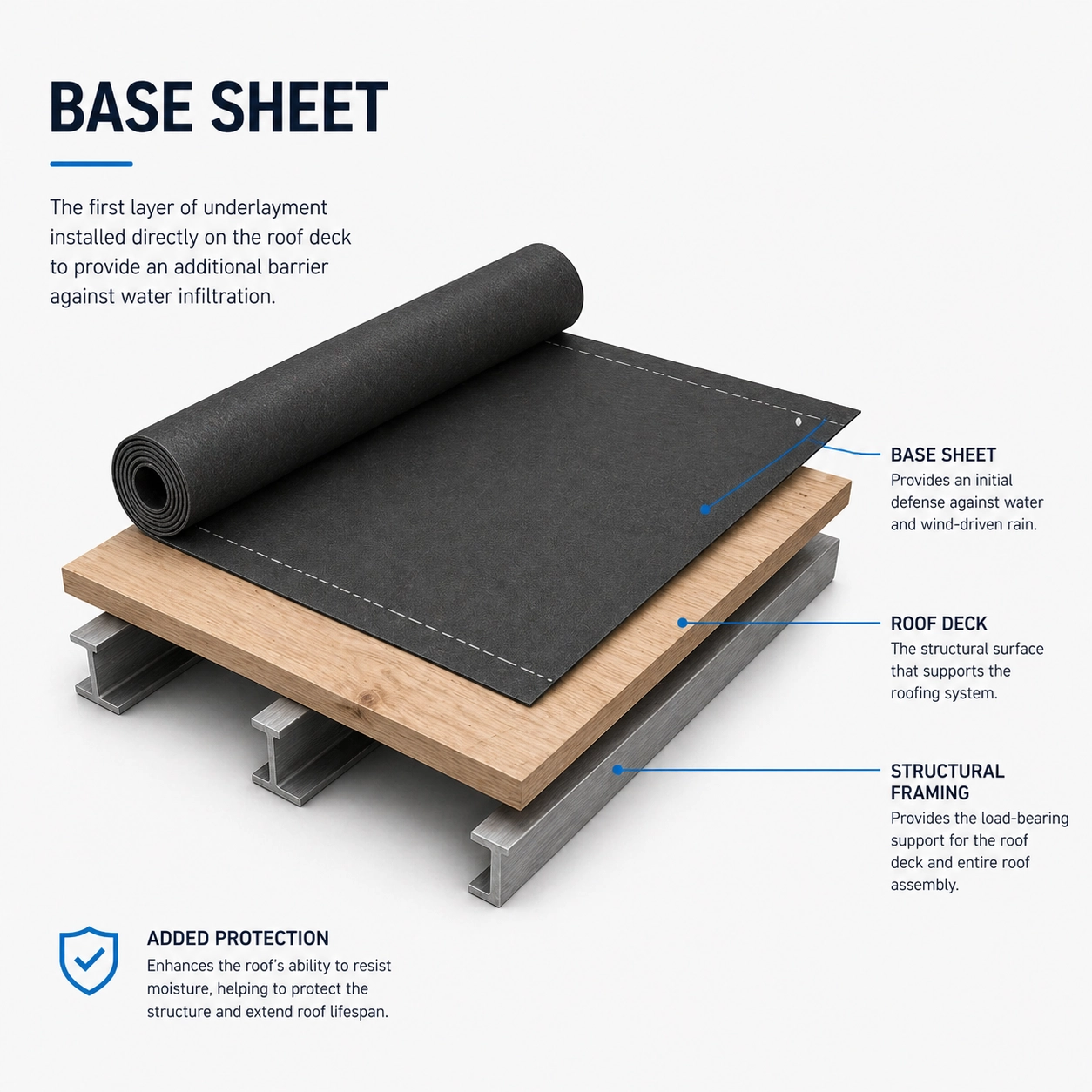
How Roofing Base Sheets Enhance System Durability, Waterproofing, and Long-Term Performance
Base sheet is the foundational ply in multi-layer low-slope roofing systems, typically installed directly over the roof deck or insulation. It is usually composed of asphalt-impregnated felt, fiberglass, or polyester mat, and serves as the initial barrier in built-up roofing (BUR) and modified bitumen assemblies. The base sheet’s geometry allows it to conform to the roof’s pitch, slopes, and transitions at critical areas such as ridges, eaves, and parapet walls, ensuring continuous coverage and structural compatibility.
Functionally, the base sheet enhances the roof’s water resistance by providing a primary layer of protection against moisture infiltration. It also improves wind uplift resistance by anchoring subsequent plies and distributing mechanical fastener loads across the roof structure. In cold climates, the base sheet contributes to snow shedding by creating a smooth substrate for upper membrane layers, reducing the risk of ice dam formation at eaves and valleys.
Base sheets are essential in commercial and industrial roofing applications where durability, redundancy, and long-term performance are required. Their use is critical in assemblies designed for efficient water drainage, structural efficiency, and resistance to environmental stresses, supporting the overall integrity of the roofing system.
How Roofing Base Sheet Is Evaluated for Roofing Performance
The roofing base sheet is evaluated for roofing performance based on its durability, compatibility with other roofing layers, resistance to weather exposure, and ability to provide a stable foundation for the overall membrane system. Professionals assess the roofing base sheet by examining its material composition—typically fiberglass, polyester, or organic felt—and its performance under real-world conditions such as UV exposure, thermal cycling, and moisture resistance. The base sheet’s tensile strength, dimensional stability, and puncture resistance are critical factors influencing its long-term service life, especially for flat roofs where water ponding and foot traffic are common.
During installation, the roofing base sheet is evaluated for proper adhesion, alignment, and integration with subsequent layers, such as the cap sheet. Roofing contractors verify that the base sheet is compatible with the chosen adhesives or fasteners and that it meets manufacturer and code requirements for the specific roof assembly. The lifespan and durability of the roofing base sheet are also considered, as premature failure can compromise the entire roofing system. Cost, installation process, and the specific demands of the building’s environment further influence the selection and evaluation of the base sheet, ensuring it delivers reliable performance throughout its intended service life.
Overview & Key Considerations
What Is Base sheet
Why Base sheet Matters
Benefits of Base sheet
MOISTURE BARRIER PROTECTION
Base sheets provide a critical waterproofing layer that helps prevent moisture intrusion into the roofing system’s substrate.
IMPROVED SYSTEM DURABILITY
The base sheet enhances overall roof longevity by adding tensile strength and resistance to punctures and tears.
INSTALLATION COMPATIBILITY
Base sheets offer a stable, compatible surface for adhering or mechanically attaching subsequent roofing layers, ensuring proper system integration.
FIRE RESISTANCE ENHANCEMENT
Many base sheets are formulated to improve the fire resistance of the roofing assembly, supporting code compliance and occupant safety.
Limitations of Base sheet
LIMITED UV RESISTANCE
Base sheets typically degrade when exposed to prolonged ultraviolet light, requiring full coverage by subsequent roofing layers for protection.
MOISTURE ABSORPTION RISK
Certain base sheet materials can absorb moisture if not properly installed, leading to compromised adhesion and potential membrane failure.
TEAR AND PUNCTURE SENSITIVITY
Base sheets are more susceptible to tearing or puncturing during installation compared to cap sheets or reinforced membranes.
TEMPERATURE INSTALLATION CONSTRAINTS
Some base sheet materials become brittle in cold weather or overly pliable in heat, complicating proper handling and securement.
Common Base sheet Problems
UV DEGRADATION
Prolonged ultraviolet exposure causes base sheet embrittlement, leading to surface cracking and premature membrane failure.
CHEMICAL INCOMPATIBILITY
Base sheet material may react adversely with certain adhesives or coatings, resulting in delamination or loss of adhesion.
THERMAL SHRINKAGE
Repeated thermal cycling can cause base sheet shrinkage, creating membrane gaps and exposing seams to water infiltration.
MOISTURE ABSORPTION
Base sheets with poor moisture resistance absorb water, promoting blistering, rot, and accelerated deterioration of the roofing assembly.
Base sheet Quick Facts
Use Cases for Base sheet
COLD CLIMATE PROTECTION
Base sheet is used as the foundational ply in multi-layer roofing systems to enhance waterproofing and freeze-thaw durability in cold regions.
LOW-SLOPE ROOFING
Base sheet provides a stable substrate for torch-applied or hot-mopped membranes on low-slope commercial roofs, improving adhesion and system longevity.
RE-ROOFING OVER OLD SYSTEMS
Base sheet is installed over existing roofing to separate new membranes from incompatible or rough substrates, preventing chemical reactions and surface irregularities.
FIRE-RATED ASSEMBLIES
Base sheet is specified in assemblies requiring enhanced fire resistance, serving as a critical layer to meet code-mandated fire ratings.