
What Is a Roof Boot? Function and Role in Roofing Systems
TL;DR Boot Summary
A boot is a pre-formed flashing component designed to seal around roof penetrations such as vent pipes or electrical masts. Because it prevents water intrusion at vulnerable points, a properly installed boot is critical for maintaining the roof’s watertight integrity. Failure, improper fit, or material degradation of the boot can lead to leaks, interior damage, and costly repairs.
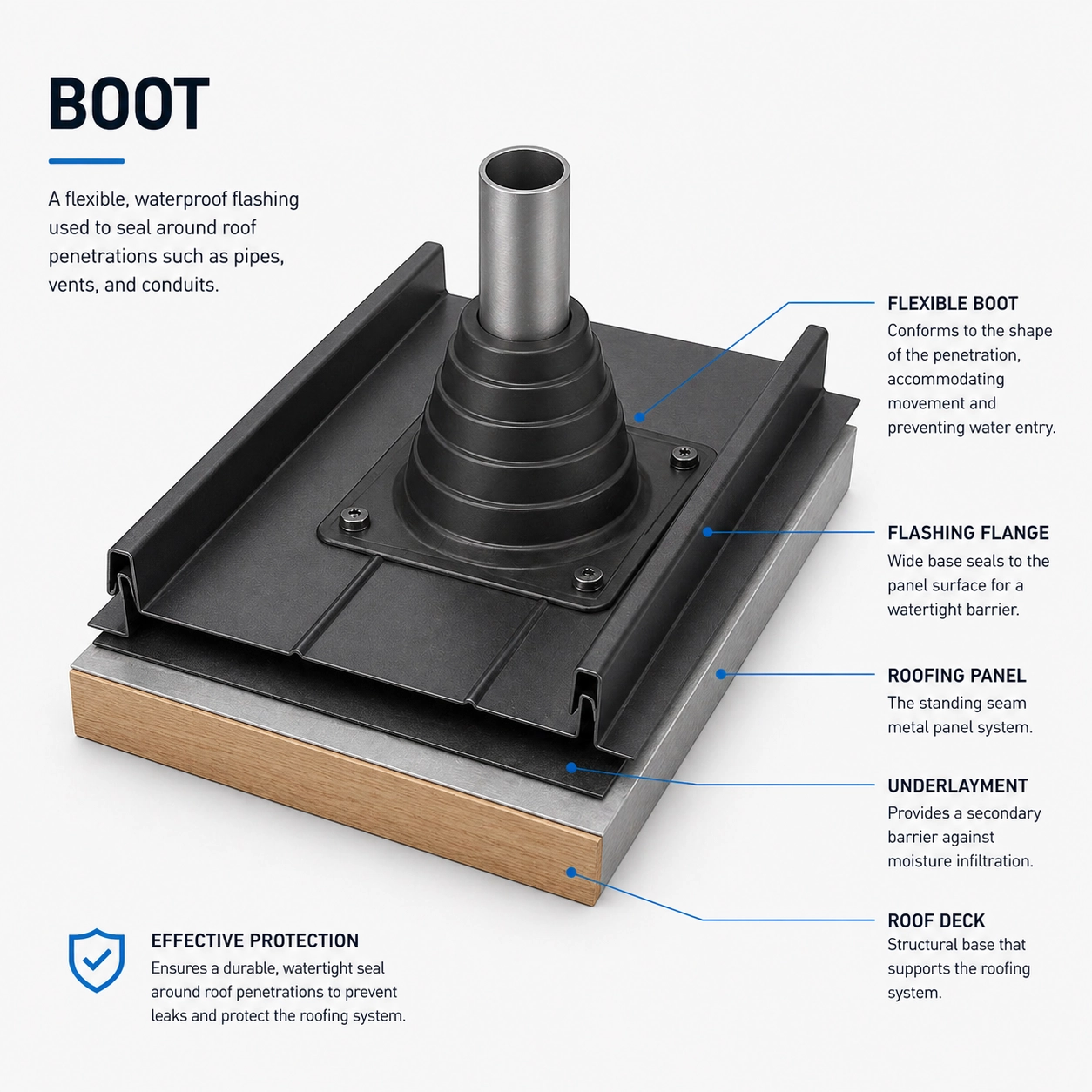
How Roof Boots Prevent Leaks and Protect Vulnerable Roof Penetrations
Boot, in roofing terminology, refers to a specialized flashing component designed to seal around roof penetrations such as vent pipes, plumbing stacks, or electrical conduits. Structurally, a boot is typically made from flexible materials like rubber, silicone, or metal, and is shaped to fit snugly over cylindrical or irregular penetrations. Its base is engineered to conform to the roof pitch and surface, ensuring a watertight seal at the intersection of the penetration and the roofing membrane or shingles.
The primary function of a boot is to prevent water infiltration at vulnerable points where pipes or vents pass through the roof deck. By accommodating movement and thermal expansion, the boot maintains its seal over time, enhancing the roof’s resistance to leaks, wind-driven rain, and snow accumulation. Proper installation of boots is critical for effective water drainage and to protect underlying structural elements from moisture damage.
Boots are used on various roof types, including steep-slope and low-slope systems, and are commonly installed at ridges, slopes, and eaves where penetrations occur. Their application is essential for maintaining the integrity of the roofing system, especially in areas exposed to frequent precipitation or temperature fluctuations.
How Roof Boots Are Evaluated in Roofing Systems
Roof boots are evaluated within roofing systems based on their placement, integration with roofing materials, and effectiveness in maintaining a watertight seal around roof penetrations such as plumbing vents. Roofing professionals assess a roof boot’s function in waterproofing by inspecting its fit over the pipe, the integrity of its flashing base, and its compatibility with the surrounding shingles or roofing membrane. Proper roof boot installation steps are critical; misalignment, inadequate fastening, or poor sealing can lead to common roof boot problems such as leaks, premature deterioration, or uplift during high winds.
The evaluation process also considers the roof boot’s material durability and expected lifespan, especially on asphalt shingles, where UV exposure and temperature fluctuations can accelerate wear. Roof boot failure causes are typically identified through visual inspection for cracks, splits, or gaps at the boot or its flashing, as well as signs of water intrusion in the attic or interior. Roofing professionals distinguish between a roof boot vs flashing by verifying that the boot provides a flexible, weather-resistant seal around the pipe, while the flashing diverts water away from the penetration. When assessing the need for replacement, factors such as the age of the roof boot, evidence of water damage, and the roof boot replacement cost are weighed to determine the most effective and economical solution for maintaining the roof’s integrity.
Overview & Key Considerations
What Is Boot
Why Boot Matters
Benefits of Boot
WATER INTRUSION PREVENTION
A boot seals around roof penetrations, preventing water from entering and causing leaks or structural damage.
SYSTEM INTEGRATION
Boots enable secure transitions between roofing materials and penetrations, maintaining the integrity of the overall roofing system.
UV AND WEATHER RESISTANCE
A properly installed boot protects vulnerable areas from UV degradation, wind-driven rain, and temperature fluctuations.
FAILURE POINT PROTECTION
Boots reduce the risk of premature roof failure by safeguarding common penetration points from moisture and debris infiltration.
Limitations of Boot
SEAL FAILURE RISK
Boots are prone to cracking or splitting over time, leading to water intrusion at pipe or vent penetrations.
UV DEGRADATION
Many boot materials degrade under prolonged ultraviolet exposure, reducing their lifespan and protective effectiveness.
INSTALLATION SENSITIVITY
Improper alignment or fastening of a boot can compromise its seal, making it highly dependent on correct installation.
COMPATIBILITY DEPENDENCY
Boots must be compatible with both the roofing material and penetration type, limiting their universal applicability across systems.
Common Boot Problems
SEAL FAILURE AT PENETRATIONS
Boots that lose adhesion or crack allow water intrusion at pipe or conduit penetrations, leading to interior leaks.
UV DEGRADATION CRACKING
Prolonged UV exposure causes boot material to degrade and crack, creating direct pathways for moisture entry.
IMPROPER SIZING GAPS
Incorrectly sized boots leave gaps around penetrations, compromising the watertight seal and enabling wind-driven rain infiltration.
AGING AND BRITTLE FAILURE
Boots become brittle with age, losing flexibility and splitting under thermal movement, resulting in recurring leak points.
Boot Quick Facts
Use Cases for Boot
PIPE PENETRATION SEALING
A boot is installed around vent pipes to create a watertight seal and prevent leaks at roof penetrations.
ELECTRICAL CONDUIT PROTECTION
Boots are used where electrical conduits pass through the roof, shielding the opening from water intrusion and weather exposure.
PLUMBING VENT FLASHING
A boot is essential for flashing plumbing vent stacks, integrating with roofing materials to maintain system waterproofing.
HVAC ROOF UNIT INTEGRATION
Boots are applied at HVAC line penetrations to ensure weatherproof transitions between rooftop equipment and the building interior.