
What Is Roof Underlayment? Function and Role in Roofing Systems
TL;DR Underlayment Summary
Underlayments are protective layers installed directly beneath the primary roofing material to provide secondary water, moisture, and weather resistance. They matter because they help prevent leaks and structural damage if the outer roof covering fails or is compromised. Choosing the right underlayment is critical, as improper selection or installation can lead to premature roof failure, especially in climates with heavy rain, snow, or wind-driven moisture.
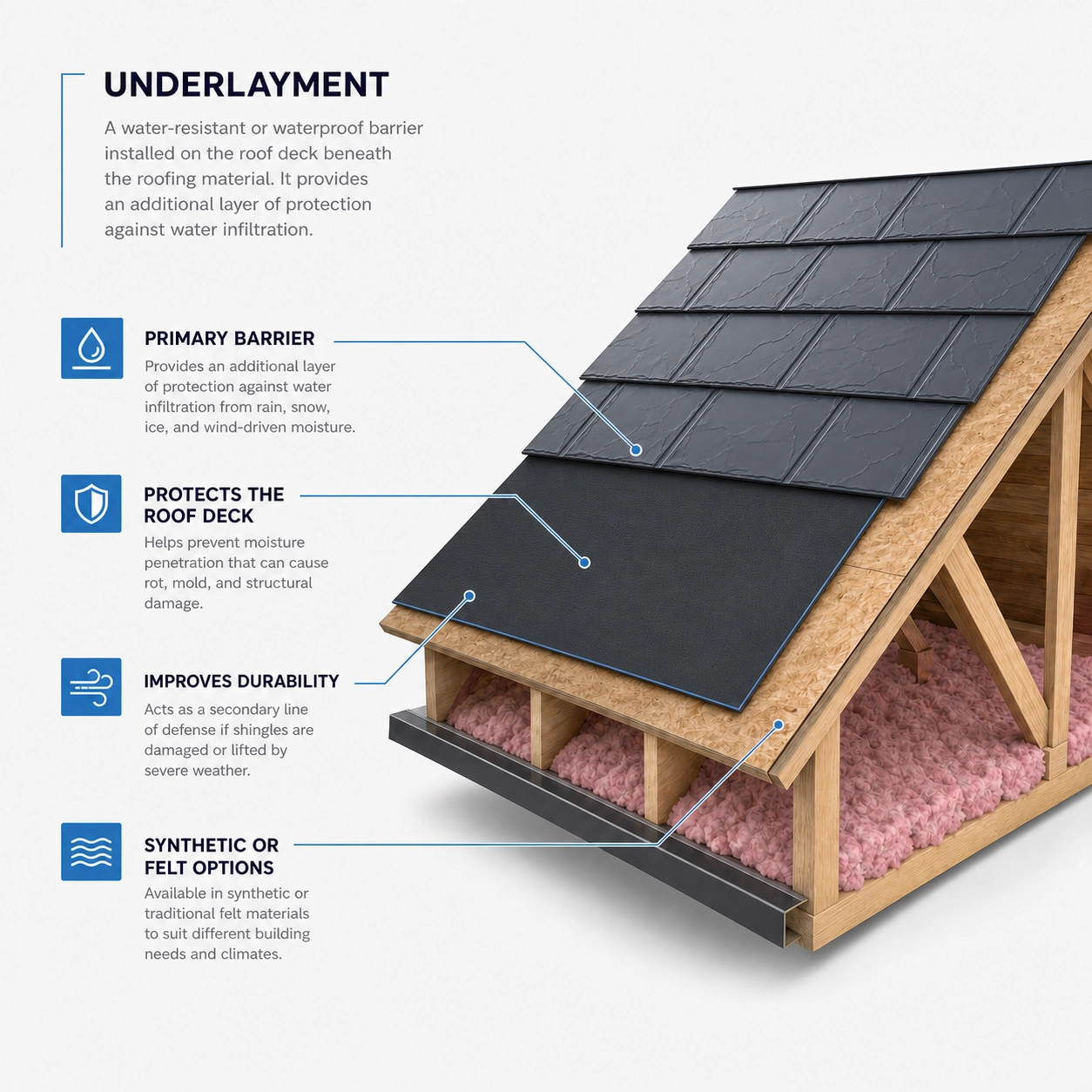
How Roof Underlayment Enhances Weather Protection and Extends Roof Lifespan
Underlayments are secondary water-shedding layers installed directly over the roof deck and beneath the primary roofing material, such as shingles, tiles, or metal panels. Structurally, underlayments are typically manufactured as rolls of asphalt-saturated felt, synthetic membranes, or rubberized asphalt, and are applied parallel to the eaves, extending up the roof slope toward the ridge. Their geometry ensures continuous coverage across the roof’s surface, including critical transition points like valleys, hips, and penetrations.
Functionally, underlayments serve as a protective barrier against water infiltration caused by wind-driven rain, ice dams, or snow accumulation, especially on low-slope or complex roof pitches. They enhance the roof assembly’s resistance to moisture intrusion, provide temporary weather protection during construction, and contribute to wind uplift resistance by stabilizing the primary roofing material. Underlayments are essential in climates with heavy precipitation, freeze-thaw cycles, or high winds, and are specified according to roof slope, local building codes, and the type of roofing system. Their performance directly impacts the longevity and structural efficiency of the entire roof assembly, safeguarding the underlying structure from water damage and extending the service life of the roof.
How Roof Underlayments Are Evaluated in Roofing Systems
Roof underlayments are evaluated within roofing systems based on their placement, function, and integration with other roof components. Roofing professionals assess underlayments for their ability to provide a secondary water-shedding barrier beneath the primary roof covering, ensuring effective water management and protection against wind-driven rain or ice damming. The evaluation process considers compatibility with the chosen roof covering—such as asphalt shingles or metal panels—and the specific requirements for roof underlayment for metal roofs, where slip resistance, heat tolerance, and moisture control are critical.
Key factors influencing the assessment include the type of underlayment (e.g., asphalt-saturated felt, synthetic, or self-adhered membranes), the roof underlayment installation process, and the quality of fastening and overlaps at seams and penetrations. Professionals also examine the underlayment’s lifespan and durability, especially in climates with extreme temperature fluctuations or high moisture exposure, as these conditions can accelerate wear or reveal roof underlayment problems and failures. In cold climates, the benefits of specialized underlayments—such as ice and water shields—are weighed for their enhanced protection against freeze-thaw cycles.
Cost factors are considered in relation to performance, with higher-quality or specialty underlayments often justified by longer service life and reduced risk of water intrusion. Ultimately, the evaluation of roof underlayments is a comprehensive process that balances material properties, installation quality, climate suitability, and integration with the overall roofing system to ensure long-term roof performance and reliability.
Overview & Key Considerations
What Is Underlayment
Why Underlayment Matters
Benefits of Underlayment
SECONDARY WATER BARRIER
Underlayments provide a critical layer of protection against water infiltration beneath primary roofing materials during severe weather events.
MOISTURE MIGRATION CONTROL
They help prevent condensation and trapped moisture from reaching the roof deck, reducing the risk of rot and mold.
SYSTEM INTEGRATION
Underlayments enhance overall roof system performance by bridging gaps between roof deck and coverings, supporting seamless component integration.
FAILURE PREVENTION
They reduce the likelihood of leaks and structural damage by serving as a backup defense if primary roofing materials are compromised.
Limitations of Underlayment
MOISTURE TRAPPING RISK
Improperly installed underlayments can trap moisture against the roof deck, leading to rot or mold development.
FASTENER PENETRATION WEAKNESS
Nail or staple penetrations through underlayments create potential pathways for water intrusion, especially if not properly sealed.
UV DEGRADATION LIMIT
Many underlayments degrade rapidly when exposed to sunlight, limiting their effectiveness if roofing installation is delayed.
DEPENDENCY ON OVERLAY
Underlayments rely on the integrity of the primary roofing material above; failure of the top layer exposes them to rapid deterioration.
Common Underlayment Problems
EDGE LAP FAILURE
Improperly sealed underlayment laps at eaves or rakes allow wind-driven rain to penetrate and cause localized leaks.
FASTENER BACKOUT
Incorrect fastener placement or overdriven nails in underlayments create puncture points, leading to water intrusion beneath the roof covering.
UV DEGRADATION EXPOSURE
Prolonged exposure of underlayments to sunlight before roof covering installation accelerates material breakdown and reduces waterproofing effectiveness.
WRINKLING UNDER SHINGLES
Moisture absorption or poor installation causes underlayment wrinkling, creating uneven surfaces that compromise shingle adhesion and water shedding.
Underlayment Quick Facts
Use Cases for Underlayment
ICE DAM PROTECTION
Underlayments are installed beneath roofing materials in cold climates to prevent water intrusion from ice damming at eaves and valleys.
SECONDARY WATER BARRIER
Underlayments provide a critical backup layer to block water infiltration if primary roof coverings are damaged or displaced by wind.
SLOPED ROOF INTEGRATION
Underlayments are required on steep-slope roofs to ensure proper drainage and protect roof decks from moisture before final coverings are applied.
CODE COMPLIANCE REQUIREMENT
Building codes mandate specific underlayment types and installation methods to meet fire, wind, and weather resistance standards for various roof assemblies.